
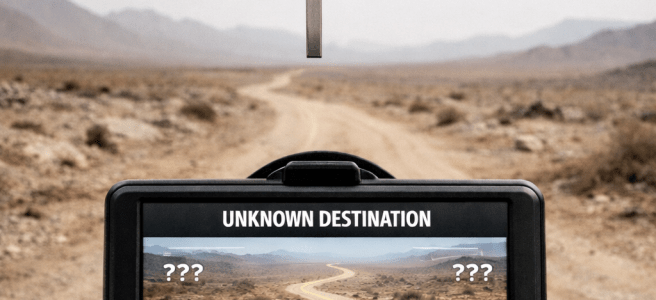
By faith Abraham obeyed when he was called to go out to a place that he was to receive as an inheritance. And he went out, not knowing where he was going.
The Holy Bible: English Standard Version (Heb 11:8). (2025). Crossway Bibles..
I’m writing this post while snowed in. Not literally, I’m blessed to live in a house that doesn’t allow for snow to cover up our doors and keep them closed. Though the county has deemed non-emergency driving to be an arrestable offense. So, I’m writing about someone not knowing where they are going when I am going absolutely nowhere.
Whether you’re going somewhere unknown, currently unable to go anywhere, or have somewhere you want to go but don’t know how, they all require faith.
Your word is a lamp to my feet and a light to my path.
New Revised Standard Version: Updated Edition (Ps 119:105). (2021). Friendship Press.
Each step in our lives should be guided by the Lord. But today, I want to look specifically at how Abraham had faith while not knowing the destination. Imagine trusting your GPS but also being unable to zoom out beyond your immediate surroundings when heading to an unknown destination. Many of us would find that to be crazy! If we twist the Scriptures, we can say that life was very different when Abraham lived, OR that Abraham is just a character in a moral story. Obviously, this is the wrong choice. Matthew, Luke, Paul, and the author of Hebrews all place great importance on the story of Abraham, Isaac, Jacob, and Joseph. Taking out those authors would leave us with only 10 books. Spoiler Alert: Jesus and our remaining New Testament authors also believed in this story. To be a Christian is to believe in Jesus the Messiah first and the Bible, which reveals Christ, second.
This is not to claim you can separate Jesus from the Word. Just without the historical crucified and risen Messiah, our faith is nothing. If we think of the witness of Christ as buying a car, we can associate faith as the process of driving to and from a destination.
- Start the car—Faith in Jesus
- Put the car in drive—Bible study & discipleship
- Drive to your destination—Evangelism & sanctification
- Put the car in park— Reflection & recalibration
- Stop the car—Rest in Jesus
This is continuous throughout the life of faith. You can’t really skip steps. You can jump out of the moving car or abandon your faith (I would strongly recommend against both). This entire process is also much more nuanced than I illustrated. Ignoring the witness of Christ is unorthodox—we can liken that to stealing a car. So if Jesus and the biblical authors trusted the story of Abraham, we are not exempt.
Now, we can finally dig into why Abraham is a story we can trust to emulate. The first and most profound example is that it parallels the first disciples. They were called by Jesus and followed him—not knowing truly what that meant until after the resurrection! They were literally following a GPS to an unknown destination. Their GPS was just Jesus.
The preacher affirms the Genesis perspective. In both Genesis and Hebrews, Abraham is the example of one who lives in faithful obedience because he trusts God and believes that God will fulfill His promise of blessing even though he cannot see that fulfillment
Cockerill, G. L. (1998). Hebrews: a Bible commentary in the Wesleyan tradition (p. 238). Wesleyan Publishing House.
How much do you truly trust God? Is it enough to leave your home and travel around simply trusting him with each and every step? This is different from Moses. The Israelites were being oppressed. Abraham owned land and livestock and trusted him enough to leave. This is more similar to Matthew leaving the lucrative business of collecting taxes to become a nomad and follow Jesus. Leaving something bad for something unknown is much easier than leaving something comfortable for it. Living in the twenty-first century and being more comfortable are not reasons to have less faith. This is not the age to put more faith in the “American Dream” than in the God of Abraham, Isaac, and Joseph.
I have a rather lengthy virtual interview on Thursday night with a church that is no less than a 400-mile drive away from where I currently live. I applied for the position, assuming it was a pipe dream because it seemed too good to be true. Through God’s grace, I’ve made it to the third round of the application process. Maybe God had me start, take a break, and finish my Master’s Degree so that it would line up perfectly with this job being posted. I was asked to do this interview on a rare evening that I am free. I worked at a church in the same denomination, which led me to enroll in one of the denomination’s graduate programs close to home. God’s provision is laced throughout this brief story. This week, I’ve decided to lean further into my faith that he will provide and put my trust in His will.
Last week, I disclosed that one of my spiritual gifts is faith. My mom would certainly agree with that. In high school, I pretty much guaranteed her that I would go to the school I chose, that I would run cross country and track on scholarship, and what I would study. It didn’t happen all at once, and the catch was that my brother, who graduated only one year before me, applied there and couldn’t afford to go. In the end, I had every cent covered, started school with 11 college credits, and moved in early for cross country camp. I know my God will provide for me, even if I don’t know where I’m going.
Faith is not always a strong suit for every Christian. Sometimes it goes through seasons. Sometimes it is just hard. Belief and hope are there, but trust is not as strong. Regardless, we are called to expect God to provide. In the coming weeks, I plan to expand on what God’s radical provision and our radical faith can look like. For now, I want to leave you with a quote about Abraham’s faith.
‘Faith’ here is not a general religious attitude to life. It’s not simply believing difficult or impossible things for the sake of it, as though simple credulity was itself a virtue. The faith in question, as becomes increasingly clear throughout the chapter, is the faith which hears and believes the promise of God, the assured word from the world’s creator that he is also the world’s redeemer, and that through the strange fortunes of Abraham’s family he is working to build…
Wright, T. (2004). Hebrews for Everyone (p. 133). Society for Promoting Christian Knowledge.
 Moments with Emmanuel