
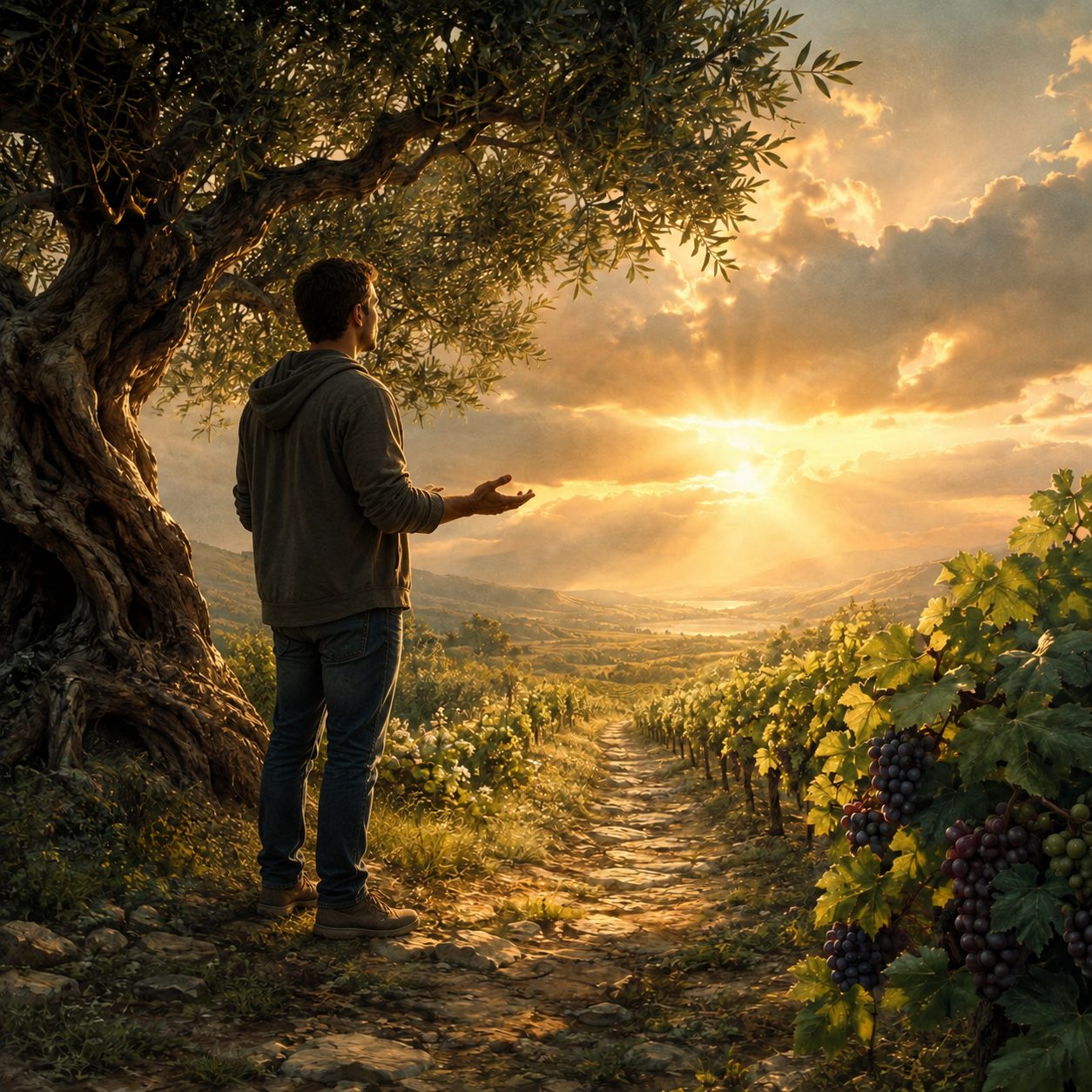
When we surrender, it is vital to remember whom we are surrendering to. We do not surrender to any deacon, pastor, priest, presbyter, teaching elder, archpriest, dean, archdeacon, district superintendent, circuit superintendent, presiding elder, bishop, archbishop, metropolitan, presiding bishop, primate, general superintendent, patriarch, catholicos, or pope. We surrender only to the one true God: the Maker of heaven and earth, the risen Messiah, the God of Abraham, Isaac, and Jacob, the Rock of Ages, the Alpha and the Omega. We do not surrender because we are weak. We surrender because He is greater. His greatness does not force our submission; His gracious love invites our trust. When we trust Him, we can be transformed.
Remain in me, and I in you. Just as a branch is unable to produce fruit by itself unless it remains on the vine, neither can you unless you remain in me. I am the vine; you are the branches. The one who remains in me and I in him produces much fruit, because you can do nothing without me. If anyone does not remain in me, he is thrown aside like a branch and he withers. They gather them, throw them into the fire, and they are burned. If you remain in me and my words remain in you, ask whatever you want and it will be done for you. My Father is glorified by this: that you produce much fruit and prove to be my disciples. “As the Father has loved me, I have also loved you. Remain in my love. If you keep my commands you will remain in my love, just as I have kept my Father’s commands and remain in his love. “I have told you these things so that my joy may be in you and your joy may be complete.
Christian Standard Bible (Jn 15:4–11). (2020). Holman Bible Publishers.
This passage offers hope and a warning. This is common in the Bible because the invitation to salvation is not an easy one. There is no cruise control on the highway to holiness. Idolatry was rampant in both the Old and New Testaments. Even the Pharisees had idols right under their own noses—becoming so obsessed with the Torah and the Temple that they missed God when he dwelled among them. Surrender is not passivity but the understanding that the will and ways of the Father our greater than our own. To assume we can live life our way and still be sanctified is the greatest folly of them all.
Jesus speaking of fruit gives us an echo of Paul’s letter to the Galatians. We cannot say with complete certainty that Jesus and Paul had the same fruit in mind. Despite this, I am under the assumption that the fruit being discussed in each passage would make a Venn diagram with a large center section. It may not have been identical, but it seems unreasonable for it to be two completely separate and diverse concepts. It seems more likely that we cannot grasp the entirety of what either passage means alone, let alone what they mean together. Regardless, the will of God is that we will produce fruit. Sometimes we may even wish we could change God’s will.
“Father, if you are willing, remove this cup from me. Nevertheless, not my will, but yours, be done.” And there appeared to him an angel from heaven, strengthening him. And being in agony he prayed more earnestly; and his sweat became like great drops of blood falling down to the ground.
The Holy Bible: English Standard Version (Lk 22:42–44). (2025). Crossway Bibles.
Even Jesus saw what the will of the Father was and prayed that it would be changed. Ultimately, it was not and He was given the strength. Why? Because the will of God supersedes all. Nothing we do can limit or stop God’s will. Many of us would affirm it then struggle with it in practice. True Christian living isn’t just affirmations. True Christian living is being transformed.
Here then are the stages of Christian moral transformation: first our mind is renewed by the Word and Spirit of God; then we are able to discern and desire the will of God; and then we are increasingly transformed by it.
Stott, J. R. W. (2001). The message of Romans: God’s good news for the world (p. 324). InterVarsity Press.
Stott gives us a progression of how God changes us to align us with His will. It begins with the renewal of the mind. That is not the end goal. That is not the destination on the GPS. It is not until after our minds have been renewed by the Word and the Spirit that we can begin to discern God’s will. A sinful and unrepentant mind cannot discern and desire the will of the Father. Without choosing the will of God, we cannot be sanctified. We cannot transform ourselves. We are not the source of holiness. It is also not forced upon us—we must choose to love and obey God. Idleness will never produce fruit. Abiding is not being idle.
To end this series, I want to leave you with Eugene Peterson’s paraphrase of Romans 12:1-2 as a benediction.
So here’s what I want you to do, God helping you: Take your everyday, ordinary life—your sleeping, eating, going-to-work, and walking-around life—and place it before God as an offering. Embracing what God does for you is the best thing you can do for him. Don’t become so well-adjusted to your culture that you fit into it without even thinking. Instead, fix your attention on God. You’ll be changed from the inside out. Readily recognize what he wants from you, and quickly respond to it. Unlike the culture around you, always dragging you down to its level of immaturity, God brings the best out of you, develops well-formed maturity in you.
Peterson, E. H. (2005). The Message: the Bible in contemporary language (Ro 12:1–2). NavPress.


Leave a Reply